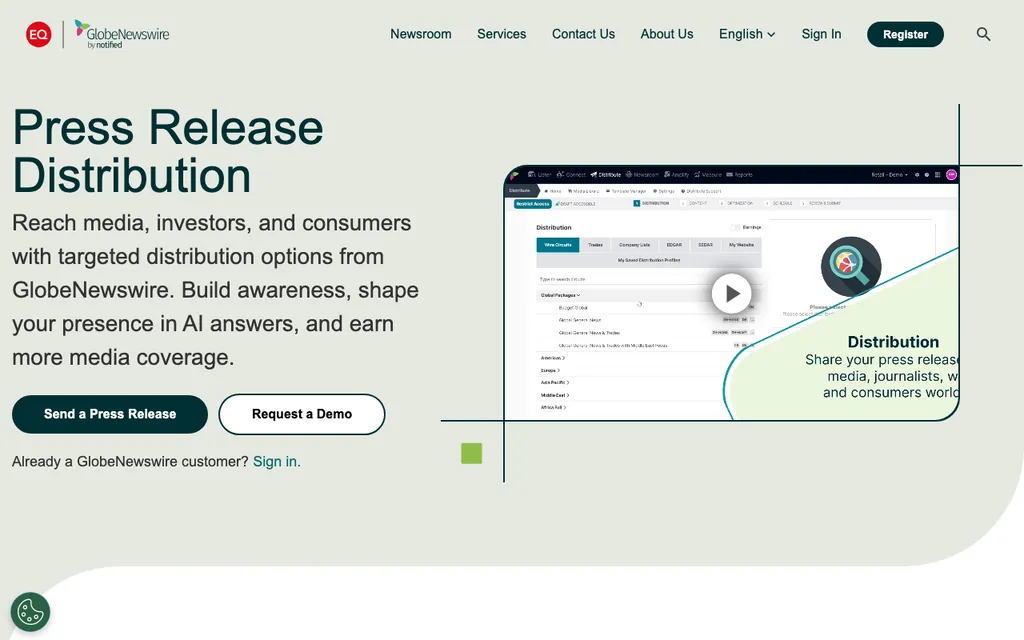
GlobeNewswire is one of the names you keep hitting when you research disclosure wires, and one of the hardest to price. There's no rate card on the site, no public package list, just a form that routes you to a demo. So before you book that call, here's a straight look at what GlobeNewswire (now part of Notified) actually does, what it tends to cost, what the reviews are really telling you, and the five alternatives worth comparing depending on whether you're filing regulatory news or running a marketing campaign.
Key takeaways
- Pricing is quote-only. GlobeNewswire publishes no USD pricing. You register or book a demo, and cost depends on membership plus per-release distribution. Expect figures in line with peer premium wires that run roughly $1,000+ per national release.
- It's built for investor relations and regulatory disclosure: earnings, 8-Ks, regulatory filings — not budget marketing announcements.
- The Trustpilot score (1.9/5 from 13 reviews) is misleading. Most of it comes from people who received press emails, not paying IR clients. Treat it with skepticism, but don't ignore the legitimate complaint about inflated hit counts.
- For most SMBs and marketers it's overkill. Transparent options from $15 to $499 cover the same goals: visibility, indexing, earned coverage, for a fraction of the spend.
- Press release links are nofollow and don't pass ranking value. The real SEO and AI benefit comes from the coverage and brand mentions a release can earn, not from the wire itself.
In this article
What GlobeNewswire (Notified) is
GlobeNewswire is a premium press release wire built around investor relations and regulatory disclosure. If a public company needs to push out quarterly earnings, a material event or a regulatory filing to financial terminals, news databases and the markets at large, this is the kind of service it reaches for. It now operates under Notified, the communications platform that absorbed it, so you'll often see the two names used together.
The distinction worth holding onto: GlobeNewswire sits in the same tier as PR Newswire and Business Wire, the incumbent disclosure wires that public companies and IR teams have used for decades. That tier exists to satisfy fair-disclosure obligations and to land your news in the places institutional investors and financial journalists watch. It is not designed to be a cheap way to get a product launch onto a few hundred local news sites. Knowing which job you're hiring a wire to do matters more than any single feature, and it's the first thing we'd raise on a discovery call.
So who's the real customer here? Public companies, IR departments, and the agencies that serve them. Compliance is the point. The brand carries weight with the financial press precisely because it's been the channel for regulated disclosure for a long time, and that reputation is most of what you're paying for.
How it works
GlobeNewswire follows the classic premium-wire model, which looks very different from the self-serve sites where you upload a release and pay by card.
- Registration and membership. You start by registering or requesting a demo. There's no checkout. A sales conversation establishes your needs, your distribution geography and, usually, a membership relationship rather than a single one-off purchase.
- Per-release distribution on top of membership. Once you're set up, each release carries its own distribution cost layered on the membership. The price scales with reach: local, national, financial, global — and with add-ons like multimedia, translation and analytics.
- Disclosure-grade delivery. The wire pushes your release to financial terminals, news services, databases and websites, with the timestamping and audit trail that regulated disclosure requires. This is the part that justifies the premium for IR teams: the question isn't whether it published, but whether you can prove it published, when, and where.
- Demo and quote flow. Because everything is bespoke, your actual number comes out of that demo. Two companies with different geographies, volumes and feature needs can pay very different amounts.
If your news isn't regulated (a funding announcement, a hire, a partnership), this whole apparatus is more than you need. Our own distribution process is built for that case: editorial review, journalist targeting by beat and region, and a placement report you can actually show a client or a board.
GlobeNewswire pricing
Here's the honest version: GlobeNewswire does not publish pricing. There's no public USD rate card, no tier list, no per-release figure on the site. To get a number, you register or book a demo, and the cost is built from a membership plus per-release distribution priced to your geography and features.
GlobeNewswire's quote-only model and the provider prices in this article were re-verified in August 2026; the cross-market averages come from our June 2026 pricing survey. Prices can change, so always confirm on the provider's site.
What we can tell you is where the tier sits. GlobeNewswire is a quote-only premium wire, the same model PR Newswire uses; Business Wire, the third incumbent, at least publishes a $475 starting price for a one-time 400-word U.S. local release. For context, the street range for a single national release on a comparable tier-1 wire runs roughly $1,000+, with one third-party reseller estimate for PR Newswire landing around $1,145 to $1,875 for a single national release. GlobeNewswire is in that neighborhood. If your budget tops out in the hundreds rather than the thousands, this is a sign to look at the transparent options below.
The gap is the story. Across the 13 providers that publish transparent entry pricing, the average first-tier cost is $168 and the median is $120, with the cheapest real paid release starting at $15. Quote-only wires like GlobeNewswire effectively start an order of magnitude higher. That premium can be justified for regulated disclosure where compliance and audit trails matter. For marketing reach, it rarely is. That is a point we dig into in our full 2026 pricing comparison across 10+ providers.
| Provider | Entry price | Model | Rating | Best for |
|---|---|---|---|---|
| GlobeNewswire / Notified | Custom / quote | Membership + per release | 1.9/5 (13 reviews) | IR & regulatory disclosure |
| Newswire Distribution | $49 / release | Per release, transparent | 4.9/5* | Proof-of-placement, journalist targeting |
| PRNow | Free / $15 per release | Free tier + paid tiers to $149 | 4.7/5*, rated Great on Trustpilot | Budget visibility, free tools |
| eReleases | $399 / release | Per release (resells PR Newswire + AP) | 4.4/5 (78 reviews) | Affordable national wire reach |
| PR Newswire / Cision | Custom / quote | Membership + per release | 2.0/5 (10 reviews) | Public companies, IR, big brands |
| Business Wire | From $475 | One-time U.S. local release; ongoing plans quoted | 3.8/5 (2 reviews) | Enterprises, financial disclosure |
Ratings marked with * are our editor's score from testing; other ratings are Trustpilot snapshots (August 2026).
Pros and cons
Pros
- Trusted name in financial and regulatory disclosure circles.
- Reaches financial terminals, databases and the news services IR audiences watch.
- Disclosure-grade timestamping and audit trail for compliance needs.
- Global distribution options with translation and multimedia.
- Membership model fits high-volume IR teams filing regularly.
Cons
- No public pricing, so you can't compare without a sales call.
- Effective cost runs well into four figures, overkill for SMB marketing.
- Membership commitment, not casual one-off use.
- Release links are nofollow; no direct SEO ranking value.
- At least one PR specialist has reported inflated hit-count reporting.
What the reviews actually say
This is where you have to read carefully, because the headline number is genuinely misleading. GlobeNewswire holds a 1.9/5 on Trustpilot from 13 reviews as of August 2026, on an unclaimed profile. Taken at face value that looks damning. Look at who's writing the reviews, and at how few there are, and the picture changes.
The page is dominated by people complaining about unsolicited press emails, recipients of press release distribution, not paying IR clients. Thirteen reviews is a tiny sample for a wire this size, and a handful of irritated inbox owners can drag the average anywhere. Someone annoyed that a release landed in their inbox is reviewing the wrong thing entirely. They never bought the product. That makes the score close to meaningless as a signal of whether GlobeNewswire does its actual job well for the companies that pay for it. We'd say the same about any wire whose review page fills up with recipient complaints, and it's why we treat low review counts on premium wires with a grain of salt.
That said, don't wave away the legitimate criticism buried in there. At least one PR specialist has reported inflated hit counts: distribution metrics that read better than the real-world pickup justified. That's a fair thing to probe in your demo: ask exactly how reach is counted, what "potential audience" means versus actual placements, and whether you'll get verifiable URLs rather than a syndication estimate. The difference between "your release reached 100 million potential viewers" and "here are the named outlets that ran it" is the whole game.
Our position on this is consistent across these wires: a vanity reach number is not proof. A list of named outlets, each with a live link, is. That's the standard we hold ourselves to, and it's worth holding any provider to before you sign.
5 GlobeNewswire alternatives
If you've decided GlobeNewswire is either too expensive, too opaque, or simply the wrong tool for marketing news, here are five alternatives that cover the realistic use cases, from transparent paid distribution with proof of placement, to the other tier-1 wire, to doing it yourself for free.
1. Newswire Distribution
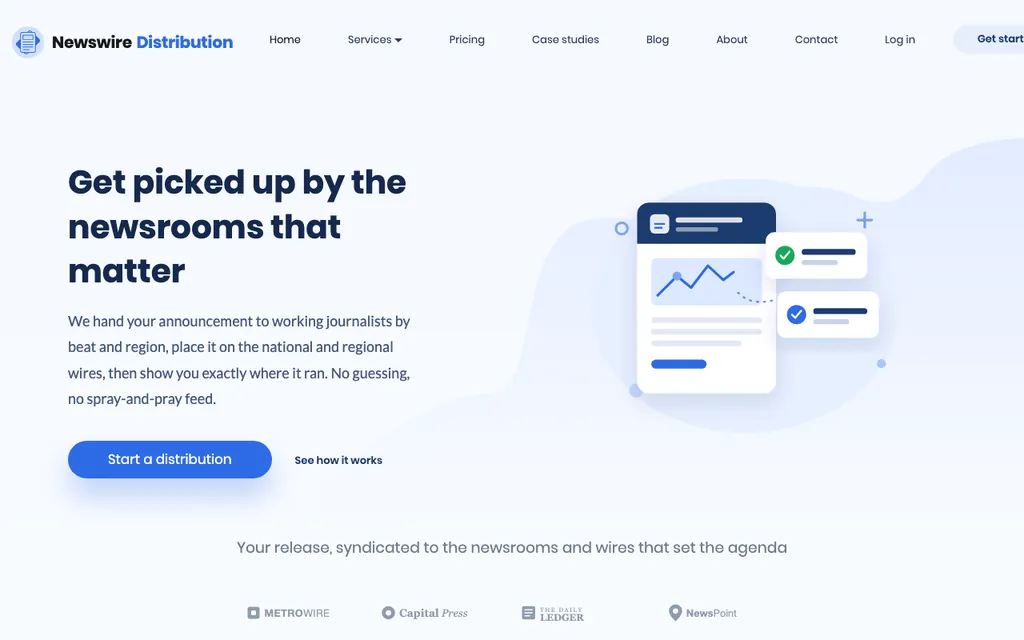
Transparent pricing and verifiable placements, the opposite of a quote-only black box.
How it works: You submit a release, our editors review it, and we target journalists by beat and region using real newsroom relationships. Every placement is reported with a live URL and a dated screenshot, and each one is reported back to you with a live URL and a dated screenshot. Plans run Starter $49, Growth $199, and Enterprise on a custom quote.
Who it suits: Brands and agencies that want to prove a release worked, rather than trust a reach estimate. If you've ever had to put a placement report in front of a client or a board, this is built for you.
Pros
- Transparent per-release pricing from $49, verified August 2026.
- Guaranteed placements reported with URL and screenshot.
- Real journalist targeting and editorial review.
- Far cheaper than quote-only premium wires.
Cons
- Newer and independent, so the name carries less weight with IR desks than the incumbents.
- Not a regulated disclosure wire for earnings or filings.
- No free tier.
2. PRNow
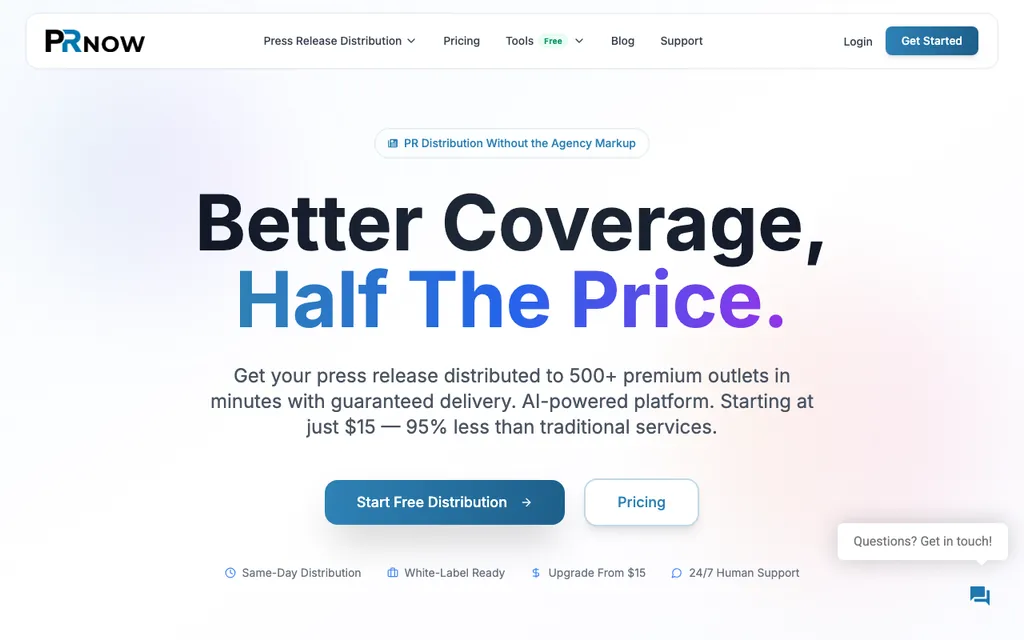
A genuinely free tier, paid distribution from $15, and 10+ free PR and SEO tools you can use without an account.
How it works: PRNow gives you a free plan that publishes one release to five news domains, no card required, once a month. Paid plans are one-time payments per release: Basic at $15 (400+ publishers), Standard at $29 (500+ publishers plus 100+ TV and radio sites), and Advanced at $149 with every premium add-on included, among them AP News and USA Today. Distribution is same-day on working days, each release carries up to five links, three images and a video, and you get a full report with links under a published-or-refunded policy. Agencies can buy reseller credits at $21.75 per release with 10+ credits. Our editor's score is 4.7/5, and it's rated Great on Trustpilot.
Who it suits: Cost-sensitive teams who want to test the water for free, then pay a small amount for a fast, broad blast, plus anyone who wants the free tools.
Pros
- Free entry point plus 10+ free SEO and AI tools.
- Paid wire from $15, the cheapest transparent option; premium outlets from $149.
- Same-day distribution and a published-or-refunded policy.
Cons
- Broad syndication rather than one-to-one journalist pitching or IR-grade disclosure.
- Premium outlets such as AP News and USA Today are paid add-ons below the Advanced tier.
3. PR Newswire / Cision
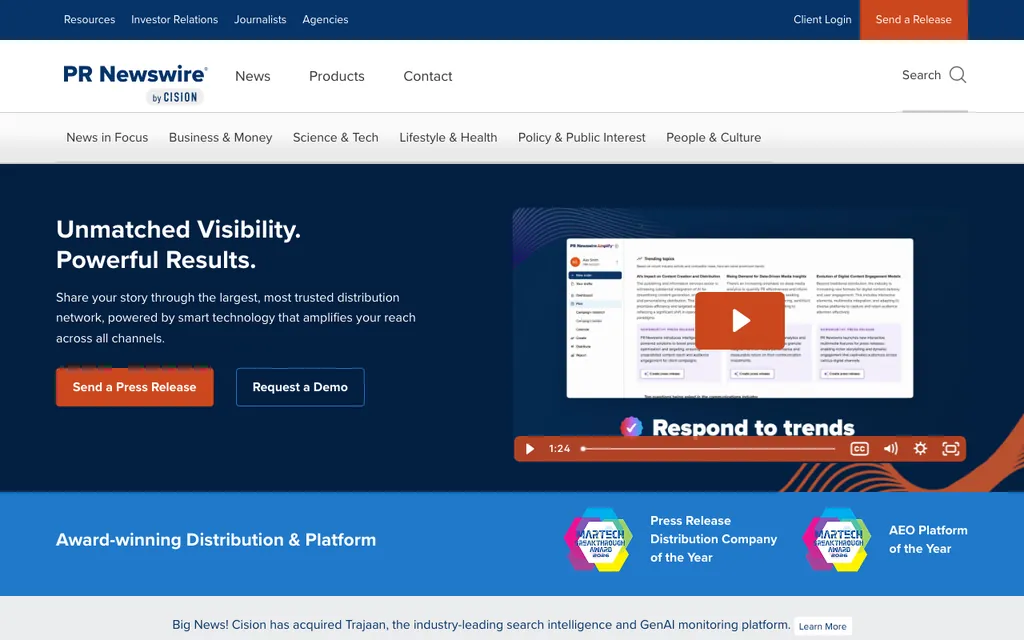
The other tier-1 incumbent, the direct peer to GlobeNewswire for IR and big-brand news.
How it works: Like GlobeNewswire, PR Newswire is quote-only, built on a membership plus per-release model with no public pricing. Third-party reseller figures put a single national release in the roughly $1,145 to $1,875 range. It's the wire many public companies default to for IR, regulatory and major-brand announcements.
Who it suits: Public companies and IR teams who want the most established disclosure brand and can absorb four-figure releases.
Pros
- The benchmark name in disclosure-grade distribution.
- Deep reach into financial terminals and the trade press.
Cons
- Quote-only, no transparent pricing.
- Expensive, and its own Trustpilot score sits at 2.0/5 from 10 reviews (August 2026).
4. eReleases
National PR Newswire and AP reach at a fraction of the direct cost, with the strongest Trustpilot score among the major paid wires.
How it works: eReleases resells Cision's PR Newswire plus AP, so you get genuine national wire reach with transparent pricing: Buzz Builder $399, Newsmaker $499, PR Pro $699 per release. First orders get 30% off, and a press-release writing add-on runs $300. It holds a 4.4/5 on Trustpilot from 78 reviews (rated Excellent, August 2026), the strongest score among the major paid wires we track.
Who it suits: SMBs that want PR Newswire and AP distribution without the membership and four-figure entry of buying direct.
Pros
- Real national PR Newswire + AP reach from $399.
- Strongest Trustpilot score among major paid wires at 4.4/5.
- Transparent pricing and a 30% first-order discount.
Cons
- Still pricier than budget syndication wires.
- Not purpose-built for regulated IR disclosure.
5. DIY free wires + journalist pitching
For early-stage budgets: publish a hosted release for free, then pitch the reporters who actually cover your beat.
How it works: Free options like PRNow's free tier, PRLog and openPR give you a hosted, indexable release page at no cost. None of them earns real media pickup on its own. Free PR sites carry low domain authority and nofollow links, so the work is in the second half: writing a tight release and emailing it directly to journalists who cover your space. Done well, that's how you earn the followed links and coverage that actually move the needle.
Who it suits: Founders and small teams with more time than budget, or anyone who wants a hosted release page for indexing while they pitch.
Pros
- No cost for a hosted, Google-indexable release.
- Direct pitching can earn high-value editorial coverage.
Cons
- Free sites are low authority with nofollow links.
- Pitching is slow, manual and hit-or-miss.
- No distribution muscle or placement guarantee.
Verdict: is it worth it?
GlobeNewswire is worth it for one job and overkill for almost everything else. If you're an IR team filing earnings, material events or regulatory disclosure, a tier-1 wire with audit-grade delivery and financial-terminal reach is a reasonable line item, and GlobeNewswire belongs on your shortlist next to PR Newswire and Business Wire. Push them in the demo on how reach is counted, get the real per-release number, and confirm you'll receive verifiable placement data rather than a potential-audience headline.
For everyone else (product launches, funding news, hires, partnerships, marketing visibility) the quote-only model and four-figure effective cost are hard to justify. Transparent options from $15 to $499 hit the same goals, and several add the one thing a vanity reach number can't: proof. Remember too that no wire's own links boost your rankings; the SEO and AI upside comes from the coverage and brand mentions a release can earn, which is exactly what we explore in our piece on whether newswire services help SEO and AI rankings.
Our bias is on the table: we built Newswire Distribution around transparent pricing and verifiable placements because that's what we wished existed when we were on the buying side. If proof of placement matters more to you than a brand name on an invoice, that's the case for us, and you can read more about why we work this way.
FAQ
GlobeNewswire doesn't publish pricing. There's no public USD rate card; cost is built from a membership plus per-release distribution and comes out of a demo or registration. As a benchmark, comparable tier-1 quote-only wires run roughly $1,000+ in effective cost for a single national release, with third-party reseller figures for the peer PR Newswire landing around $1,145 to $1,875. Pricing was verified in August 2026 and can change, so always confirm on the provider's site.
For investor relations and regulatory disclosure, yes: the audit trail, financial-terminal reach and trusted brand earn the premium. With marketing news like launches, hires or funding, it's usually overkill. Transparent wires from $15 to $499 reach the same goals for far less, and some add verifiable proof of placement that a reach estimate can't match.
Its 1.9/5 from 13 reviews (August 2026) is not representative of paying clients. The sample is tiny, and the page is dominated by people complaining about press emails they received, recipients of distributed releases, not IR teams who bought the service. One criticism does deserve weight: a PR specialist's report of inflated hit counts, so ask in your demo exactly how reach is measured and whether you'll get verifiable placement URLs.
For regulated IR and disclosure, the closest peers are PR Newswire (quote-only) and Business Wire (from $475 for a one-time U.S. local release, ongoing plans quoted), the other two tier-1 wires. On the marketing and visibility side, look at Newswire Distribution ($49, verifiable placements), eReleases ($399, national PR Newswire + AP reach), or PRNow (free, then $15 to $149) for budget blasts. Founders with more time than money can publish on free sites and pitch journalists directly.
Not directly. Links inside distributed press releases are nofollow and don't pass ranking value. Google's spam policy treats optimized release links as link spam unless marked nofollow or sponsored. The real benefit is indirect: referral traffic, multi-site indexing, brand mentions and the earned editorial coverage that can attract followed links and AI citations. Our SEO and AI rankings guide covers the data behind this.
Pay for proof, not a black box
Transparent pricing from $49 and verifiable placements reported with a live URL and a dated screenshot. See exactly where your story lands.

Newswire Distribution Editorial Team
We distribute press releases through real newsroom relationships and report every placement with proof. This series breaks down the wires honestly, including where ours fits and where it doesn't, so you can choose with clear eyes.